

A company is a system.
A company is not just a product, a team or a CEO. It is a complete system.
Like a ship, each component can be excellent on its own, but the ability to keep sailing over time depends on how well they work together.
The true strength of an organization lies in the connections between its parts.
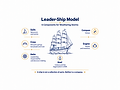
The Leader-Ship Model looks at a company through six components:
Questions and possible working outputs. These are examples, not a promise that every engagement supplies all six.
The Compass - Values
The values that define what is important to us and how we make decisions.
Which value should influence a real decision? Possible output: a definition of the value and the behavior that expresses it.
The Sails -
Behavior
The behaviors and norms that translate values into action.
What does the expected behavior look like day to day? Possible output: agreed examples of behavior and working norms.
The Keel -
Culture
The culture and organizational DNA that keep the company stable over time.
What patterns persist when pressure rises? Possible output: a map of patterns that strengthen or undermine the culture.
The Helm - Leadership and Decision-Making
Leadership, distribution of responsibility and decision-making.
Who decides, on what basis and with whose involvement? Possible output: clearer decision ownership and a decision process.
The Engine - Corporate Governance
The board of directors, investors and corporate governance.
How do leadership, the board and investors work together? Possible output: clearer roles and a reporting and discussion routine.
The Crew
The people, the trust between them and their ability to act together.
What enables people to trust one another and work together? Possible output: agreements about collaboration, asking for help and feedback.


SOS
Understanding the Company Is Only the First Step
SOS is a working method that translates the Leader-Ship Model into a practical management system.
It examines the company across three dimensions:
S - Structure
Have we built the right foundations?
Values, behaviors, accountability, authority, leadership, team, governance and decision-making mechanisms.
O - Operations
Does what we defined really happen every day?
In recruitment, onboarding, meetings, feedback, promotion, compensation, working with customers and decision-making.
S - Scale
Does the system keep working as the company grows?
More people, more customers, more money, more pressure and more complexity, without losing culture, speed or the ability to make decisions.
Many companies invest in defining values, structures and processes.
The gap appears when they are not embedded in daily work, or when they stop working as the company grows.
SOS is designed to identify these gaps and build a system that holds over time.
Build it right. Run it well. Scale it right.
The conversation I postponed, and the acquisition offer we lost
At one of the companies I led as CEO, the founders had set up the company with a founders’ agreement. A salesperson joined later and delivered significant results, and the company grew rapidly.
We promised that he would become a co-owner if he met an agreed target. He reached that target within ten months. I postponed the conversation about his place in the ownership structure, and the transition was never formalized. This is the responsibility I take in the story: the promise had been made and the target achieved, but I did not make sure we clarified and formalized the agreement in time.
When an acquisition offer worth many millions of dollars arrived, different expectations emerged about his share of the deal. That gap became a dispute. As I describe in my book “יזמאות”, the buyer sensed the tension and withdrew. The conversation I had postponed caught up with us when much more was at stake.
Market conditions later changed as well, and revenue declined. I eventually sold the company for a much lower amount than the earlier acquisition offer. There was an exit, but the larger opportunity had been missed. The dispute should not be treated as the sole cause of the decline in revenue: market conditions had also changed.
My lesson is to formalize promises in time, distinguish performance-based compensation from ownership, and clarify expectations and decision-making authority before pressure or a deal arrives. These conversations need to happen while things are working, rather than being postponed because they are uncomfortable.
This is personal experience recounted in “יזמאות”, illustrating the need for clear agreements and an organizational culture that makes room for difficult conversations in time. It is not an SOS client case or evidence of consulting outcomes.

Contact
Phone: +972-54-8142030
16 Nissim Aloni, Tel-Aviv, Israel
© 2026 by Sink Or Scale
.png)